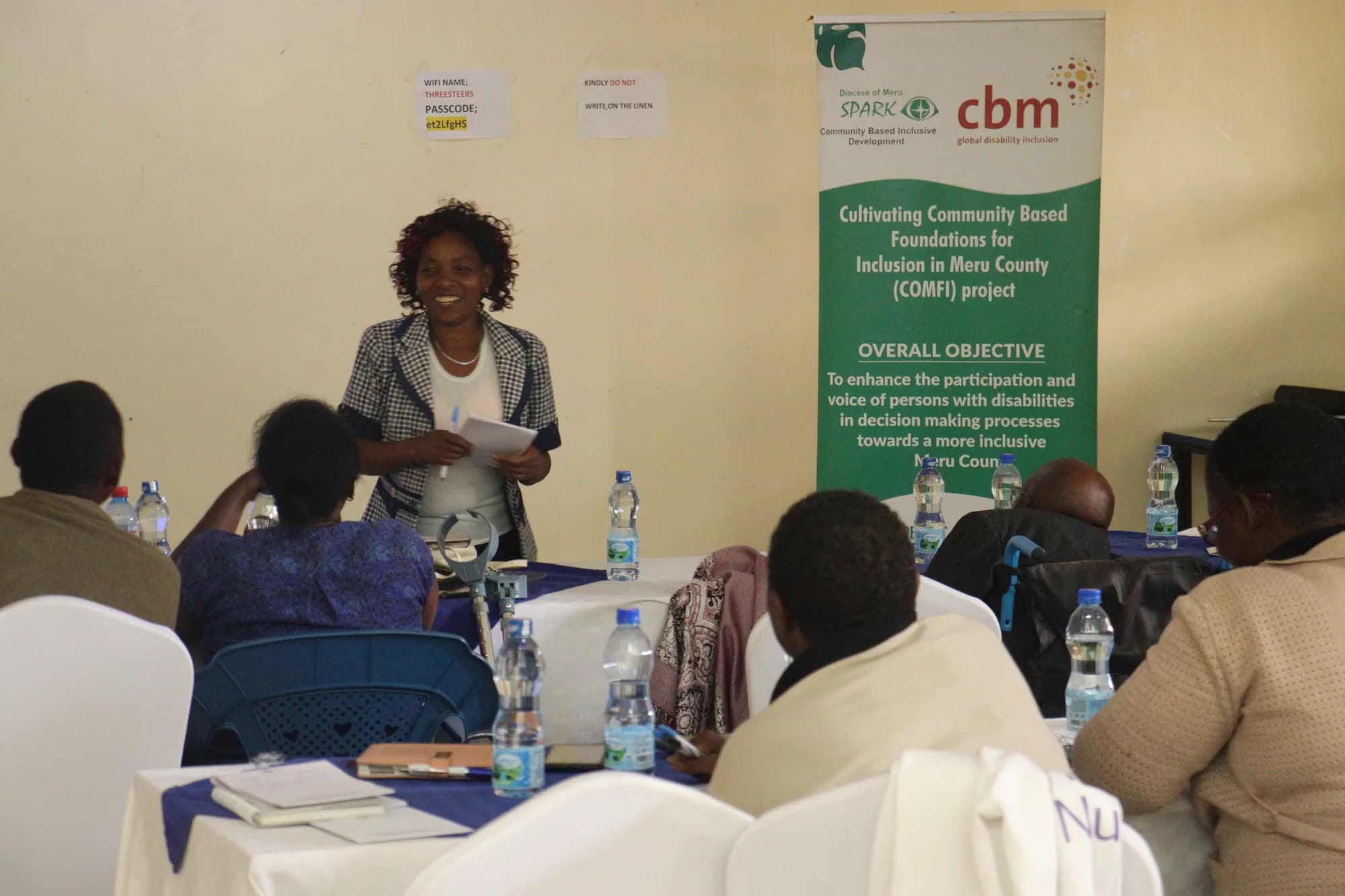
In the bustling Kathelwa market of Igembe Central, a woman named Regina Kamengere, affectionately known as “Mama Yao,” has emerged as an example of hope and change.
At 41, Regina carries several responsibilities. She is a community health promoter, a disability rights champion and the Igembe Central People with Disability Coordinator. Her nickname, “Mama Yao,” means “mother of many.”
But Regina's journey to becoming a confident advocate was not easy. Her 'limp', a consequence of a neglected club foot, subjected her to discrimination and low self-esteem.
Rather than allowing those experiences to define her, Regina turned them into determination. In 2010, she founded the Kathelwa Disability Group, bringing together people with disabilities and caregivers to advocate for their rights.
“I know that proper education is one of the most important foundations towards breaking poverty and discrimination cycle.”
— Regina Kamengere
Finding her voice
In 2020, CBM Global partnered with DOMSPARK to initiate the Meru Inclusive Trachoma WASH PLUS project, known as MINT. The project worked to empower people with disabilities through advocacy and disability-rights awareness, financial resilience through village savings initiatives, and improved access to physiotherapy and assistive devices.
MINT also fostered partnerships between service providers, government and people with disabilities, helping create a more coordinated approach to addressing inequalities.
Kathelwa Disability Group was among the organisations supported by the project in Igembe Central. Regina was also mentored by Lucy Nkatha, a disability champion who encouraged her and other local leaders to advocate for inclusive development.
Making education more inclusive
Education became one of Regina's strongest areas of advocacy. Although she did not go beyond secondary school herself, she became determined to ensure that children with disabilities had opportunities that were available to them.
Regina became a board of management member in four secondary schools and one primary school. She used these positions to advocate for accessibility and disability-friendly facilities.
At one of the secondary schools, Regina remembers being carried up the stairs during her first board meeting because there was no ramp.
“This experience was an eye opener for the school that didn't realize how lack of a ramp would affect them.”
— Regina Kamengere
She used the experience to create awareness among the school management about disability rights. The school subsequently installed a ramp and a disability-friendly latrine.
Regina also led parents of children with disabilities at Kathelwa Primary School in advocating for teachers. At the time, the school had 15 children with various disabilities but no teacher dedicated to their needs.
Through the area chief, the Kangeta Sub-County Assistant County Commissioner and engagement with the Ministry of Education and the Teachers Service Commission, two special teachers were eventually sent to the school.
Opening doors for children
Regina's advocacy did not stop at the school gate. She continued seeking support for children whose families could not afford school fees.
In 2023 alone, she lobbied for fully paid education scholarships for 35 children. In 2024, she helped five needy children who had excelled in primary education secure scholarships worth KSh 300,000, covering their secondary education for four years.
EDUCATION & OPPORTUNITY
Regina's advocacy has helped turn education from an aspiration into a practical opportunity for children with disabilities.
Her work shows how local leadership can connect families with institutions and resources that might otherwise remain out of reach.
Building economic independence
Economic empowerment became another important part of Regina's work. Kathelwa Disability Group adopted the Savings and Internal Lending Communities model introduced through the MINT project.
Members contributed regularly, pooled their savings and made loans to one another. For people living in rural areas where formal credit can be difficult to access, the model created an avenue for investment and self-development.
Regina borrowed KSh 20,000 through SILC and used it to start a food kiosk. The business grew into a source of income that could support her household and her daughter's college education.
On a good month, she can make profits of up to KSh 25,000, while slower months bring around KSh 8,000. Other members of the group have also established small businesses or invested in livestock.
Regina now hopes to borrow again and establish a cereals business at the same market.
A group grows with her
Under Regina's leadership, Kathelwa Disability Group has also developed communal enterprises. The group established a dairy goat project after receiving KSh 100,000 from the National Agricultural and Rural Inclusive Growth Project.
The group also received a KSh 80,000 grant from the National Council for Persons with Disabilities to establish a tent and chair rental business.
Area Chief Peter Gitonga says he has watched the group grow steadily.
“Initially the group looked desperate even to their faces, these days their faces have brightened and they have a lot of positive things going on.”
— Peter Gitonga, Area Chief
Changing the community around her
Regina's advocacy has also changed how local institutions think about accessibility.
The chief's office was previously not disability-friendly. Regina repeatedly raised the issue of equality and accessibility, helping the chief understand the barriers faced by people with disabilities.
She was later appointed by the community to represent people with disabilities on the development committee for the new chief's block. She ensured that a ramp was included so that people with disabilities could access services.
One of Regina's proudest achievements came in 2022, when she led efforts to reclaim land belonging to a man with a mental disability who had been abandoned by his family.
Through community mobilisation and government intervention, awareness of disability rights helped secure the reclamation of the land and the construction of a decent house for him.
FROM EXPERIENCE TO LEADERSHIP
Regina's own experience of exclusion became the foundation for her determination to challenge exclusion around her.
Her story shows how disability advocacy can move from an individual's experience to changes in schools, public services, livelihoods and community attitudes.
Regina says MINT empowered her to speak up and fight injustices affecting people with disabilities. The training she and other members received helped them understand their rights and the commitments made by government.
“If the advocacy and disability rights awareness creation would continue, we will have a very inclusive community in few years.”
— Regina Kamengere
Regina's story is ultimately about what happens when a person who has experienced exclusion finds the confidence, knowledge and community support to challenge it — not only for herself, but for many others.