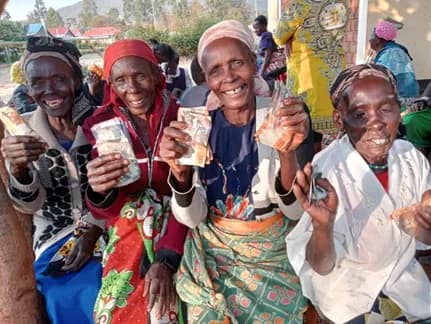
“We were once unwanted, now everybody wants to be part of us.”
In the heart of Tigania East in Meru County, the Kitharene Organization of Persons with Disabilities has emerged as a beacon of resilience and success.
The organisation's story is one of transformation — from a small group formed in response to rejection and isolation to a respected organisation whose achievements have attracted the attention of the wider community.
Finding strength together
In 2002, faced with desperation, loneliness and rejection from other community groups, Helen Kalintu and a handful of people with disabilities and caregivers formed the Kitharene disability support group.
The discrimination they experienced forced them to seek strength within their own community. That decision laid the foundation for what would become a remarkable journey of collective empowerment.
The turning point came in 2021 when the Meru Inclusive Trachoma WASH Plus project, known as MINT, reached the sub-county. Supported by CBM Global and implemented by DOMSPARK, the project worked to empower people with disabilities in areas including economic development, access to assistive devices, registration with the National Council for Persons with Disabilities, food security, advocacy and disability awareness.
Saving together, growing together
One of the important approaches introduced through MINT was the Savings and Internal Lending Communities model, or SILC.
The model enabled members to pool their savings and lend money to one another. Unlike formal lending institutions, members could access loans without the same collateral requirements that had previously made formal credit difficult to reach.
Kitharene OPD embraced the model with enthusiasm.
During its second savings cycle, from August 2022 to July 2023, the group's total cash reached KSh 465,070. The share-out ratio was 3.136, meaning members received significantly more than the amount they had individually saved.
SILC & LIVELIHOODS
Savings became more than a financial activity. They became a pathway to independence.
Members used loans and share-outs for small businesses, school fees, household needs, assets and other forms of self-development.
Lucy, the group secretary, reported that by the end of 2023, at least 12 women who had previously stayed at home or relied on casual labour were engaged in steady income-generating activities. Four of them had disabilities.
Another 30 members had acquired assets such as chickens and goats, while others were able to pay school fees and meet medical expenses more comfortably.
From savings to advocacy
Financial independence gave the group greater confidence to address other barriers facing people with disabilities.
Advocacy became an important part of the group's work. Members received training on disability rights, advocacy and lobbying strategies, facilitated by disability champion Lucy Nkatha.
Their advocacy contributed to the installation of a disability-friendly latrine at Muthaara Level 4 Hospital, demonstrating how local action could influence the accessibility of public services.
Helen also led a few group members to the Tigania East Deputy County Commissioner to petition for equality and representation on the sub-county Land Board.
“Land board representation was among our key areas of focus as a result of the many injustices people with disabilities are facing related to property and land ownership.”
— Helen Kalintu
Helen was proposed as a member and was later gazetted after vetting. Since joining the board, she has remained focused on helping avert injustices related to land ownership affecting people with disabilities.
Putting inclusion into practice
DOMSPARK also supported Kitharene OPD to establish a demonstration farm at Muthaara Hospital, where the group meets. The initiative explored alternative approaches to food security in semi-arid areas.
The group received three grow bags in which they planted kales and spinach. The vegetables produced were cooked at the hospital, while vulnerable mothers who came to the hospital with children experiencing dietary challenges also received bunches of spinach to prepare at home.
COMMUNITY ACTION
The group began turning its own experience into practical action for the wider community.
From accessible sanitation and food security to land rights and economic empowerment, Kitharene OPD's work expanded beyond the needs of its own members.
Building something that can last
To strengthen its sustainability, Kitharene OPD initiated additional income-generating activities, including soap making and a dairy goat project.
The group's commitment to community welfare also extends to parents and children living in remote villages. Members continue to counsel parents and encourage families to ensure that children with disabilities are not hidden or neglected.
But the group also recognises that important challenges remain. Some parents struggle to support children with disabilities who are beyond school-going age and need opportunities for technical training in areas such as weaving, crocheting and beading.
For some caregivers, the demands are particularly heavy. Purity Kinya, whose daughter is deaf-blind, had to stop her vegetable vending business to stay at home and support her daughter's rehabilitation after she received assistive devices that required constant use.
“If only I have some institution where I can have her placed, then I can participate in other productive work since I have other children who still need my attention.”
— Purity Kinya
Purity says her daughter, who was once doing badly, is slowly improving because of constant therapy.
From unwanted to sought after
The success of Kitharene OPD has not gone unnoticed. The group's achievements were recognised during the MINT closeout meeting in December 2023 by Meru County Committee Member for Public Health, Mr. Thuranira.
Even after the project ended, the need for continued mentorship and guidance for OPD groups practising SILC was recognised.
Perhaps the clearest sign of Kitharene OPD's transformation is the change in how the wider community sees the group.
Once marginalised and unwanted, the organisation has become a source of inspiration and admiration. Its success has even attracted requests from people without disabilities who want to join.
A GROWING COMMUNITY
Kitharene OPD had 57 active members, with another 15 people with severe disabilities at home.
Their journey demonstrates what can happen when people who have experienced exclusion come together, build their own strength and use their collective voice to influence their communities.
Kitharene OPD's story is not simply about moving from exclusion to inclusion. It is about people who were once unwanted becoming people whose participation, leadership and ideas are actively sought. Their journey shows the power of collective resilience, economic empowerment and the belief that inclusion must reach every part of community life.