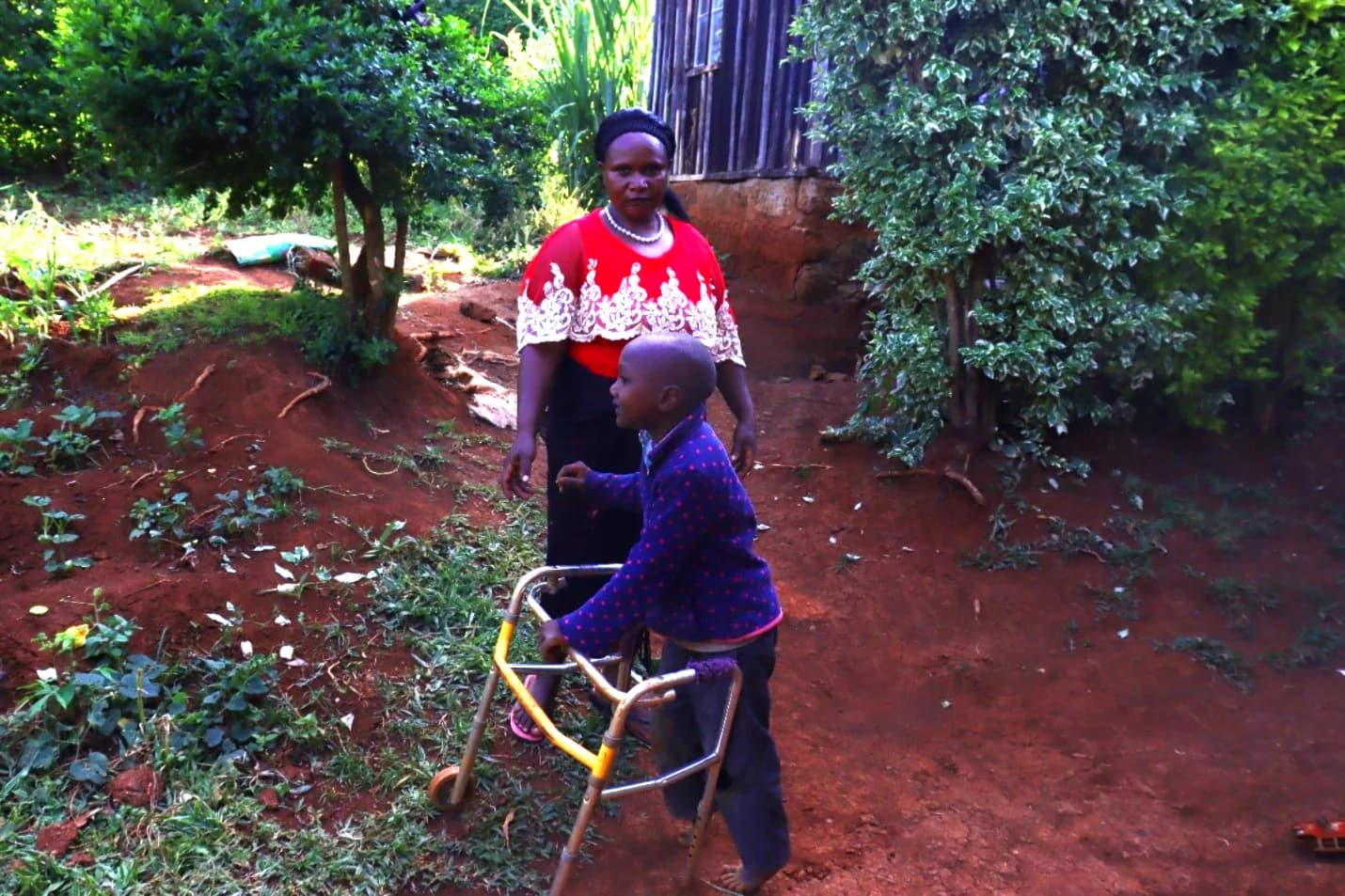
Hellen is a resilient woman from Irinda Organization of Persons with Disabilities who faced numerous challenges while raising her son Baraka, who was born with cerebral palsy.
In a community where resources were scarce and stigma surrounded disability, Hellen struggled to provide her family's basic needs while also meeting the specialised care and therapy required for Baraka.
The demands were significant. Caring for a child who needed regular therapy and support required both time and money, while Hellen still had to find ways to provide for the rest of her family.
Finding an opportunity to begin again
Despite the challenges, Hellen refused to give up hope. She joined the Irinda Organization of Persons with Disabilities SILC group, where members practise savings and lending by pooling their resources and making loans to one another.
Through the SILC group, Hellen was able to access a small loan to start a business.
She understood that any enterprise she started needed to do more than generate income. It needed to help her provide for Baraka's health and wellbeing.
A cow becomes a livelihood
Hellen decided to invest her loan in a dairy cow.
Each day, she sold the cow's milk in the local market. The income helped sustain her family and enabled her to meet Baraka's medical expenses and transport costs for therapy sessions.
What began as a small investment gradually became a more reliable source of income.
LIVELIHOODS & CARE
For Hellen, economic empowerment was directly connected to her ability to care for her son.
The income from the dairy enterprise helped her meet household needs while making it possible to continue taking Baraka for the care and therapy he needed.
Support for Baraka's rehabilitation
Alongside the livelihood support, Baraka received assistance through the SPARK intervention.
He was provided with a walking bar and an AFO to support his mobility and help him walk.
For Hellen, these forms of support complemented what she was already doing at home and through her livelihood. The combination of economic support and rehabilitation gave her more opportunities to support her son's development.
From one cow to a growing enterprise
Hellen's dairy business flourished. The steady income from selling milk allowed her to expand the enterprise and purchase more cows.
Through dedication and hard work, she was able to take Baraka to school while continuing to ensure that he received the care and support he needed.
Her progress illustrates how a small economic opportunity can have wider effects when it is connected to the needs of a family caring for a child with a disability.
Her journey became a message to others
Hellen's success did not stop with her own household. Her experience also changed how she saw her role in the wider community.
She became an advocate for disability rights, raising awareness and challenging the stigma surrounding cerebral palsy and other disabilities.
Her story encouraged people in her village to recognise the potential of people with disabilities and to support their inclusion in community life.
Her journey became a testament to the power of resilience, determination and community support.
A WIDER CHANGE
Hellen's determination to support her son became a source of encouragement for other families facing similar challenges.
Her experience shows how livelihoods, rehabilitation and community inclusion can reinforce one another in the life of a family.
Through her entrepreneurial spirit and unwavering love for her son, Hellen has worked to transform the circumstances of her family while becoming a voice for greater inclusion in her community.